Winter 2026User Experience (UX) Study - Presentation
Portland State University
The slide deck is a concise summary of our findings, but its true value lies in its role as a bridge between research and action. Creating it forced our team to distill dozens of pages of transcripts, notes, and data into a clear, compelling narrative for our client, Dr. Read. The most challenging part was deciding what to leave out. We had to prioritize our findings based on what would be most useful for the English Department to make improvements. The final "Recommendations" slide, with its four clear priorities (Fix IA, Improve SEO, etc.), is the culmination of this process. It translates complex user struggles into a concrete, actionable roadmap for the website's stakeholders, demonstrating that the ultimate goal of our research was not just to understand a problem, but to help solve it.
Competencies
Research Synthesis
Recommendation Formulation
Data Storytelling
Visual Communication
Public Speaking
Presenting to Stakeholders
Technologies
Google Docs
Google Slides
Survey Tools
Data Visualization Tools
Personal Characteristics
Creativity
Analytical Thinking
Clarity
Organization
Conciseness
Persuasion
Confidence
Winter 2026User Experience (UX) Study - Topline Report
Portland State University
This topline report is a comprehensive synthesis of our team's usability research, but its true value lies in how it translates raw data into actionable recommendations for our client, Dr. Read. Creating this report forced our team to distill hours of recorded sessions, moderator notes, and post-test debriefs into a clear, evidence-driven narrative about how prospective students actually experience the B+M Pathway website. The most challenging part was balancing the need for thoroughness with the need for clarity—we had to decide which findings were most critical for the English Department to act on first. The final "Recommendations" section, with its four prioritized fixes (Fix Information Architecture, Improve SEO, Enhance Visuals, Transfer Student Clarifications), is the culmination of this process. It translates specific user struggles—like consistently looking for the pathway under the "Graduate" menu or failing to find it via Google—into a concrete, phased roadmap for website stakeholders. This report demonstrates that the ultimate goal of usability research is not just to document problems, but to empower clients to solve them.
Competencies
Research
User Research
Written Communication
Audience Awareness/Analysis
Project Planning/Project Management
Visual Communiation
Editing
Technologies
Google Docs
Google Slides
WCAG Evaluation Tools
Survey Tools
Data Visualization Tools
Personal Characteristics
Analytical/Critical Thinking
Detail-Oriented
Problem Solving
Collaboration
Independence/Initiative
Learning
winter 2026User Research - Persona with Scenarios
Portland State University
On the surface, the creation of a persona is a simple one-page profile. But what a portfolio reader can’t see is the hours of work that went into creating him. He isn't a fictional character; he’s a composite of real data points from our pre-test survey and usability test observations. We noticed that several of our proxy users were not the "typical" undergraduate English majorS we initially planned to recruit. They were older, had established careers, and were looking at the program from a completely different field, like political science or education. Gilbert represents this entire unexpected, yet significant, user group. Creating him was an act of advocacy, a way to ensure that the needs of non-traditional and prospective students from other disciplines were not forgotten in our final recommendations. He is a constant, visible reminder that our research revealed a broader audience than the department originally anticipated.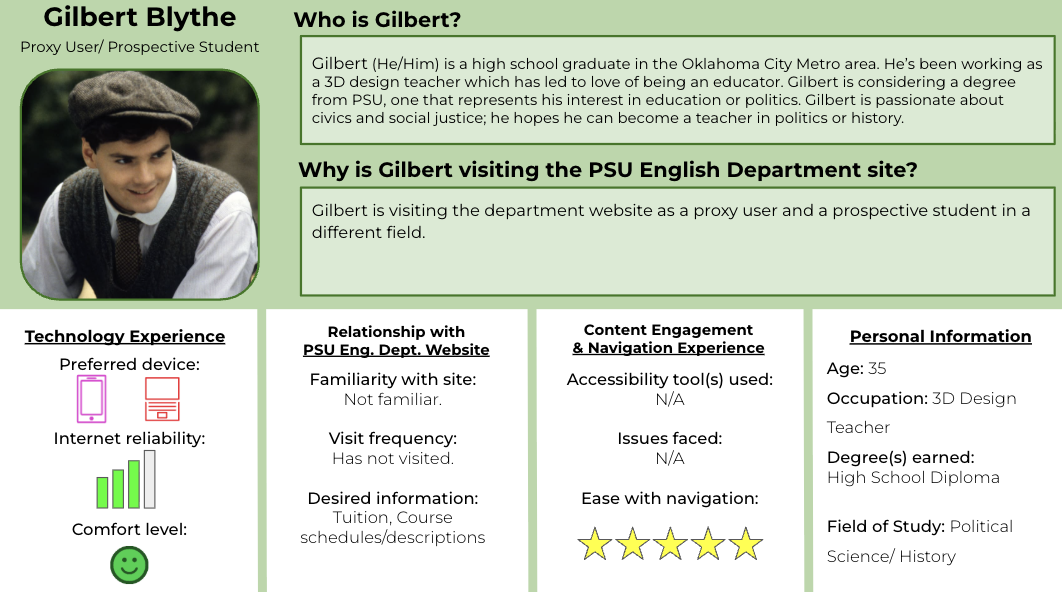
Competencies
User Advocacy
Data Synthesis
Audience Analysis
Storytelling
Technologies
Google Docs
Google Slides
PDF Software
Personal Characteristics
Creativity
Empathy
Attention to Detail
Winter 2026Creation of Usability Test Plan
Portland State University
The Usability Test Plan is the blueprint for our entire project, and its creation was an exercise in thinking backwards. We had to start with our high-level research questions—like "Can users find the program?"—and break them down into small, observable, and measurable tasks, such as "Navigate from the English homepage to the B+M Pathway page using the main menu." This process of operationalization was meticulous. For every task, we had to define the exact starting point, the ideal path, and the criteria for success. This level of detail was crucial because it ensured that every member of our research team was collecting consistent and comparable data.
Competencies
Research Design
Methodological Rigor
Operationalization
Strategic Planning
Technologies
Google Docs
PDF Software
Personal Characteristics
Foresight
Organization
Systematic Thinking
Winter 2026Accessibility Proxy Testing - Website Evaluation
Portland State University
This moderator script and note-taking form is a detailed research instrument, but its true value lies in its role as the engine that ensured consistent, ethical, and replicable data collection across our entire usability study. Creating this form forced our team to anticipate every possible variation in a testing session—from participant hesitancy to technical difficulties to different paths a user might take through the website. The most challenging part was writing language that was both neutral enough to avoid leading participants and warm enough to put them at ease. We had to balance the need for standardization (so multiple moderators could run sessions independently) with the need for flexibility (responding to participant questions or struggles in real time). The final script, with its embedded consent confirmation, "think aloud" instructions, conditional branching, and moderator-only note-taking fields, is the culmination of this process. It translates abstract research ethics and protocol into a concrete, step-by-step guide that any moderator could follow, ensuring that our findings were built on a foundation of rigor and respect for participants.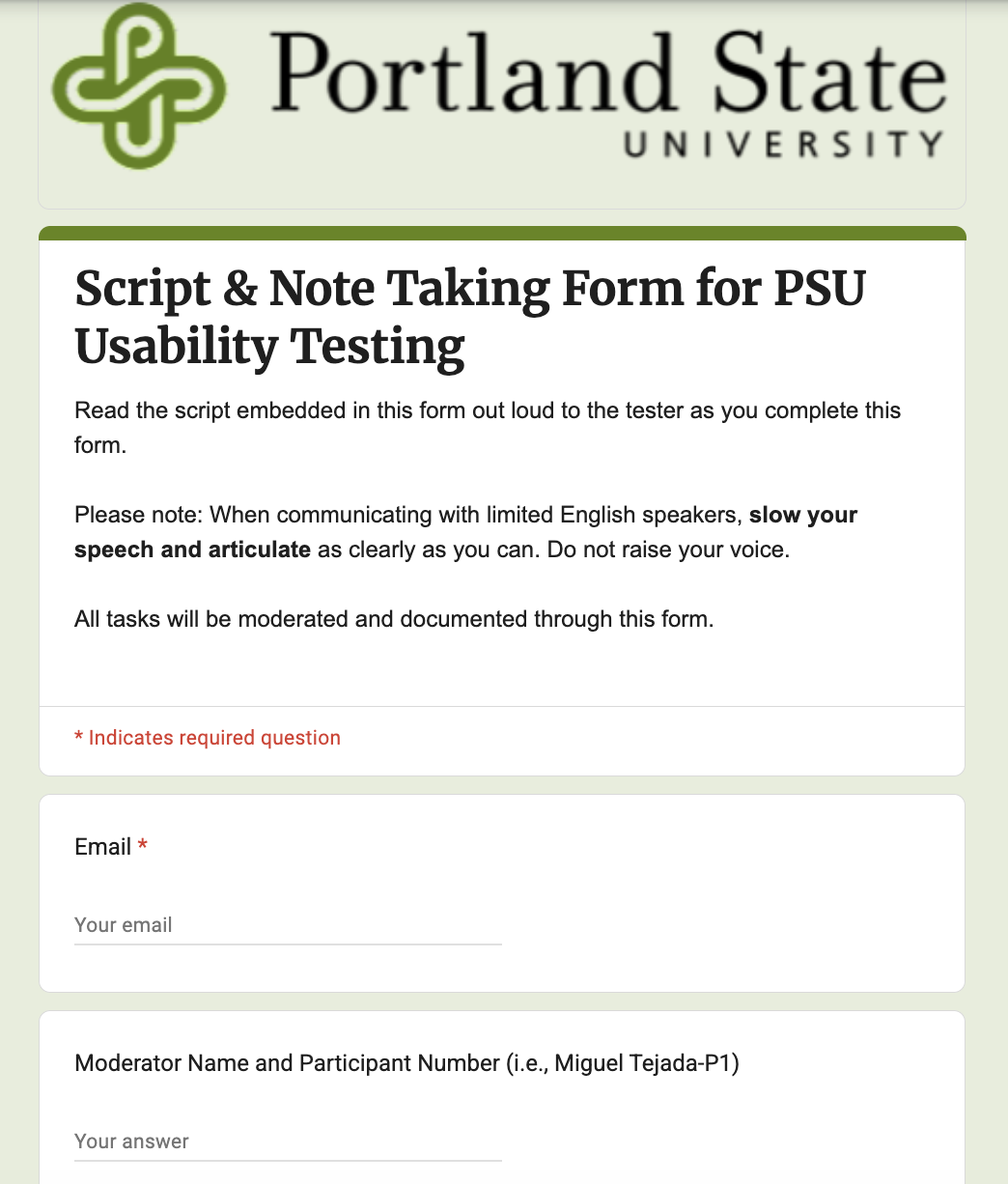
Competencies
User Research
Oral/Verbal Communication
Project Planning/Project Management
Written Communication
Audience Awareness/ Analysis
Editing
Technologies
Google Forms
Zoom
Screen Recording Tools
Personal Characteristics
Detail-Oriented
Analytical/Critical Thinking
Interpersonal
Organization
Learning
Problem Solving